
Goal-Driven AI in 2026: The Rise of Autonomous Intelligence That Thinks in Outcomes, Not Prompts
Artificial intelligence is entering a decisive transformation phase. For years, AI systems responded to instructions. Now, they are evolving toward understanding objectives, context, and success criteria.
This shift is why 2026 is widely considered the breakthrough year for goal-driven AI — systems designed to pursue outcomes rather than simply generate outputs. Businesses, researchers, and policymakers are aligning around a new paradigm:
👉 AI that plans, executes, adapts, and optimizes independently.
In this comprehensive guide, you’ll learn:
- What goal-driven AI actually means
- Why 2026 marks a turning point
- How autonomous AI agents reshape industries
- Governance and risk considerations
- Strategic adoption frameworks for enterprises
From Reactive AI to Outcome-Focused Systems
Early AI tools operated as reactive engines. They required constant human input and had limited contextual awareness.
Goal-driven AI introduces:
- Multi-step reasoning capability
- Adaptive decision loops
- Continuous optimization toward defined outcomes
- Cross-system orchestration
This evolution reflects a shift from content generation → task execution → strategic autonomy.
Key Drivers of This Shift
- Advances in multi-agent architectures
- Integration of predictive analytics with automation
- Enterprise demand for measurable AI ROI
- Improvements in reasoning-based model training
The result is an intelligence layer capable of strategic execution rather than isolated tasks.
What Are Goal-Oriented AI Agents?
These are systems capable of:
- Translating strategic objectives into executable workflows
- Managing dependencies across tools and data sources
- Monitoring performance indicators in real time
- Adjusting decisions without human intervention
They function as digital operators rather than assistants.
Core Capabilities
| Capability | Traditional AI | Goal-Driven AI |
|---|---|---|
| Decision autonomy | Low | High |
| Context retention | Limited | Persistent |
| Workflow orchestration | Manual | Automated |
| Strategic alignment | Indirect | Direct |
This transition marks the beginning of AI as an operational layer of organizations.
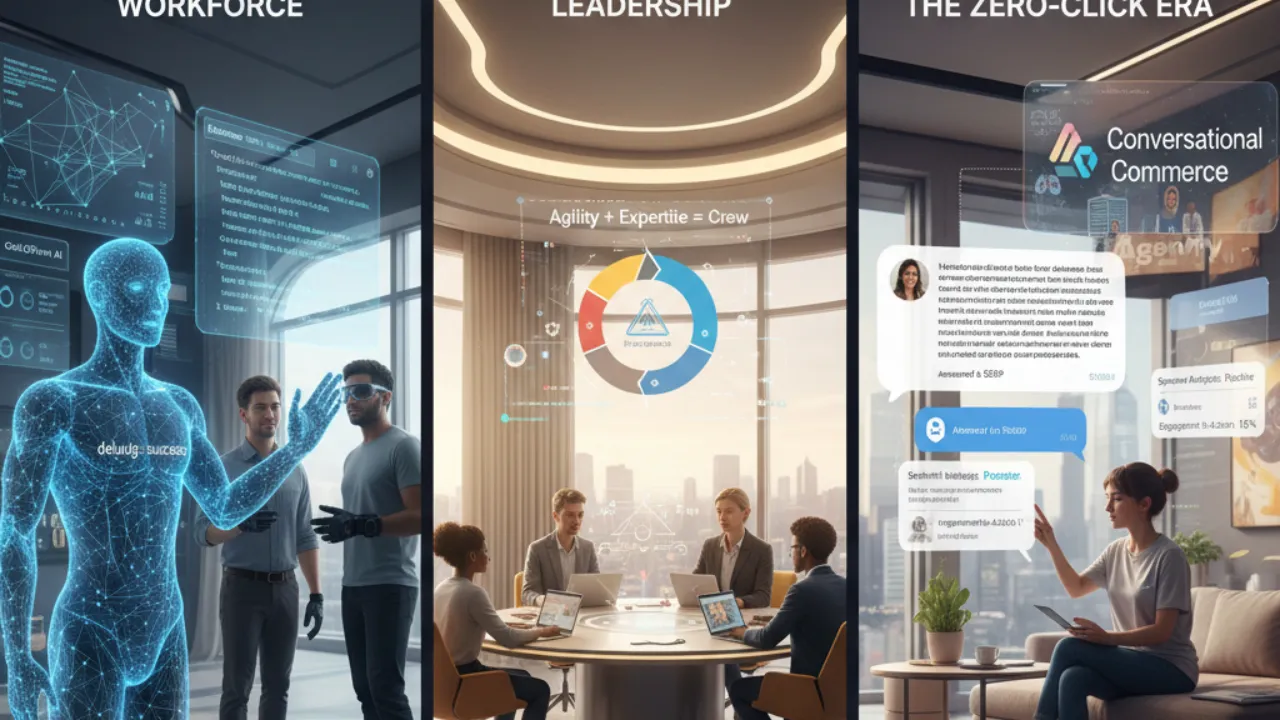
The Emergence of the Digital Workforce
Goal-driven AI will redefine knowledge work by enabling:
- Autonomous project execution
- Predictive workload balancing
- Strategic decision augmentation
- Continuous process optimization
Rather than replacing human expertise, these systems shift human roles toward:
- Strategic oversight
- Creativity and innovation
- Ethical governance
- Complex problem-solving
Productivity Implications
Organizations adopting goal-oriented AI early can expect:
- Faster decision cycles
- Reduced operational bottlenecks
- Enhanced forecasting accuracy
- Higher workforce leverage ratios
The transformation is less about automation and more about organizational intelligence amplification.
Building a Goal-Driven AI Strategy
To succeed in the agentic AI era, enterprises must move beyond tool adoption toward capability design.
Strategic Implementation Model
- Define outcome-based AI objectives
- Assess AI maturity and infrastructure readiness
- Deploy autonomous workflow pilots
- Integrate orchestration and monitoring layers
- Establish governance and compliance structures
- Train teams for human-AI collaboration
- Measure impact and optimize continuously
This framework ensures AI initiatives align with business value creation rather than technological experimentation.
Why Goal-Driven AI Requires New Oversight
Autonomous decision systems introduce risks related to:
- Misaligned objectives
- Data bias amplification
- Strategic over-reliance on automation
- Accountability ambiguity
Organizations must implement governance mechanisms including:
- Objective validation protocols
- Continuous ethical auditing
- Decision traceability systems
- Human-in-the-loop safeguards
The future of AI adoption depends on balancing autonomy with accountability.
Innovation Roadmap: 2026–2030
What Happens After Goal-Driven AI Becomes Mainstream?
Key innovation trajectories include:
- Multi-agent economic ecosystems
- Self-optimizing enterprise infrastructures
- AI-driven strategic simulation platforms
- Fully autonomous digital business units
By the end of the decade, organizations may operate with AI as a core strategic partner rather than a supporting technology.
How Businesses Can Transition to Goal-Driven AI
Step-by-Step Adoption Guide
Step 1: Define Measurable Outcomes
Identify strategic goals AI should pursue.
Step 2: Audit Current AI Capabilities
Evaluate infrastructure, data maturity, and governance readiness.
Step 3: Launch Agentic Workflow Pilots
Start with contained operational processes.
Step 4: Implement Orchestration Platforms
Enable cross-tool coordination and monitoring.
Step 5: Establish Governance Frameworks
Define accountability, risk controls, and ethical guidelines.
Step 6: Train Workforce for Collaboration
Prepare teams to supervise and enhance AI systems.
Step 7: Optimize Based on Performance Metrics
Continuously refine objectives and execution models.
FAQ: Goal-Driven AI in 2026
What is goal-driven AI?
It refers to AI systems designed to achieve defined outcomes through autonomous planning and execution.
How is it different from generative AI?
Generative AI produces outputs, while goal-driven AI manages processes to achieve measurable objectives.
Why is 2026 a turning point?
Technological maturity, enterprise demand, and ecosystem readiness converge around this timeline.
Will autonomous AI replace human roles?
It will transform responsibilities rather than eliminate expertise.
What industries will adopt it first?
Technology, finance, healthcare, and logistics show early adoption momentum.
Is goal-oriented AI safe?
Safety depends on governance, transparency, and continuous oversight.
How can companies prepare?
By building AI maturity frameworks and aligning AI with strategic outcomes.
What risks exist?
Objective misalignment, governance gaps, and over-automation.
What tools enable this shift?
AI orchestration platforms, multi-agent systems, and predictive analytics engines.
How should ROI be measured?
Through productivity gains, decision accuracy, and operational efficiency improvements.
Conclusion
Goal-driven AI represents a fundamental evolution in how intelligence integrates into business and society. By focusing on outcomes rather than instructions, organizations unlock a new layer of strategic capability.
The year 2026 is not merely another milestone in technological progress — it marks the beginning of AI as an autonomous execution partner.
Businesses that prepare early will define the next era of productivity, innovation, and competitive advantage.
👉 Stay ahead by building AI-ready strategies, governance systems, and collaborative cultures.